The watercolor paper is in the bedroom closet. The brushes share a jar with three pens. A roll of tape has disappeared into the kitchen drawer. Nothing is truly lost, but beginning Saturday’s painting session already requires a small scavenger hunt. Here is a hypothetical experiment: give one existing shelf a temporary job, then arrange it around what happens next.
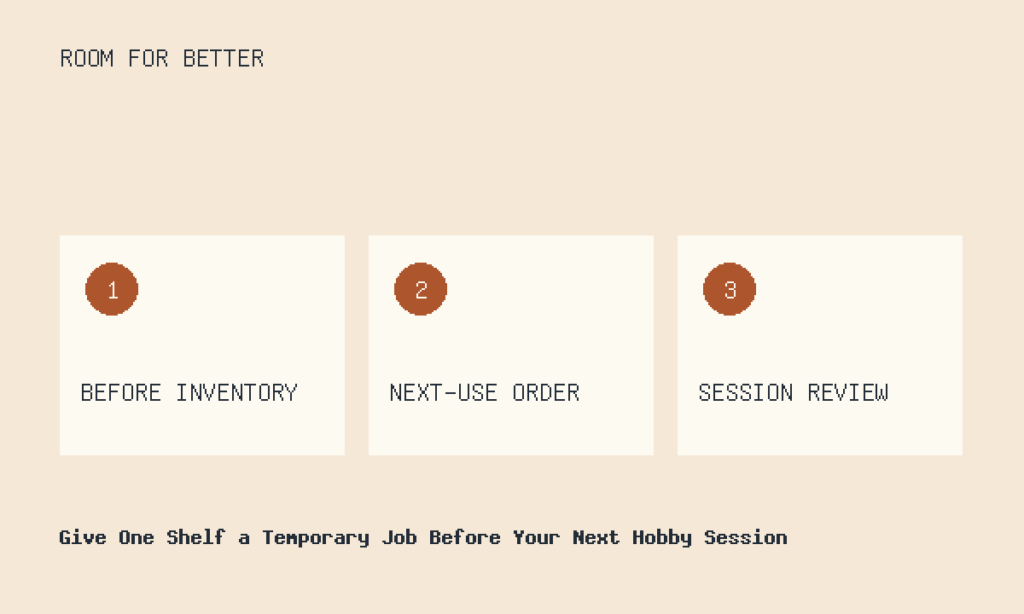
Start with the shelf as it is
Imagine a hobbyist named Lena who wants to paint four small watercolor postcards on Saturday afternoon. She chooses one shelf in a living-room bookcase as her staging area. Its short assignment is to hold the materials for this particular session until she decides what should happen next.
Before the experiment, the shelf contains two travel guides, a half-finished jigsaw puzzle in its box, a camera strap, three unopened letters, a sketchbook, and a small tin of watercolors. Only the sketchbook and paint tin belong to Saturday’s plan. The rest accumulated because the shelf was open and convenient.
Lena gives every displaced item a specific destination rather than creating a second mystery pile. The travel guides return to the row of books below. The puzzle goes beside other games. The camera strap joins the camera. The letters move to the desk where mail is handled. If an item lacks an obvious destination, that is a separate organizing question; it does not need to hijack this shelf experiment.
Arrange for the next action, not by category
Now Lena gathers the remaining materials from around the apartment: four blank postcards, a scrap sheet for color tests, two brushes, a pencil, an eraser, a roll of tape, a clean cloth, and an empty water container. Instead of making neat little categories, she asks what she will reach for first.
At the left side of the shelf, she places the postcards, scrap sheet, pencil, and eraser. These support the opening actions: choosing a card, making a light sketch, and testing a composition. In the middle go the watercolor tin, brushes, and empty water container. When the session begins, Lena carries the container to the painting table and fills it there. Tape and the cloth sit on the right because they belong to setup and cleanup rather than the central painting sequence. The sketchbook stands at the back as an optional reference, not an obstacle between Lena and the materials she definitely plans to use.
A handwritten note tucked under the postcards reads: SATURDAY: FOUR PAINTED CARDS. The note makes the shelf’s current purpose visible, so an unrelated envelope or charging cable looks immediately out of place.
Leave space for the session to change
A staging shelf should not become a display of every object remotely connected to watercolor. Lena leaves out spare brushes, old paintings, extra paper, and a book of techniques because Saturday’s plan does not call for them. If she needs one later, she can fetch it. The empty portion of the shelf gives finished postcards somewhere to wait and makes unexpected additions obvious.
There is also a simple rule for interruptions. If Saturday is postponed, the shelf remains staged until the next realistic painting time. If the plan is canceled altogether, Lena returns the materials to their previous places and releases the shelf.
Review it at the next session
When Lena sits down to paint, she pays attention to friction without stopping to redesign everything. At the end, she answers three questions on the back of the note: What did I reach for first? What did I fetch from elsewhere? What sat untouched?
Suppose the hypothetical answers are: she used the tape before the pencil, fetched a second scrap sheet, and never opened the sketchbook. For the next session, tape moves to the left with the opening materials, two scrap sheets replace one, and the sketchbook returns to its usual home. Lena’s revised setup now follows the sequence she actually used: tape and paper first, paint and water next, cloth at cleanup.
After the fourth postcard is finished, Lena can stage the shelf for another painting session, restore its original contents, or give it a completely different job. The useful result is not a permanent watercolor shelf. It is a clearer answer to a practical question: what should be waiting when the next session begins?